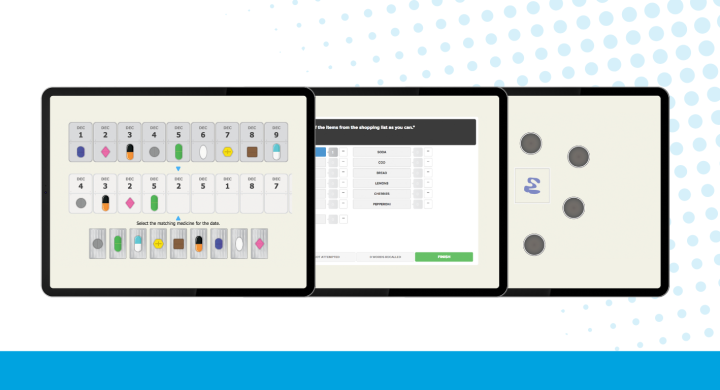
As Alzheimer’s disease (AD) clinical trials are conducted earlier in the disease continuum, efficient approaches to identify appropriate participants are increasingly important. While biomarkers remain essential for confirming underlying AD pathology, large-scale recruitment efforts require practical methods to identify individuals most likely to meet study clinical eligibility criteria.
Digital cognitive assessments offer a scalable and flexible approach to case finding for site- and community-based recruitment settings, as well as for remote use. Real-time scoring, centralized decision-making, and remote administration capabilities enable cognitive data to be incorporated into screening workflows, helping researchers identify individuals who are more likely to demonstrate cognitive impairment, be at elevated risk of progression, or exhibit biomarker evidence of AD pathology. However, optimal case finding using digital cognitive assessments requires that the decisions made, and actions recommended, be defined clearly and understood broadly.
This webinar will review key considerations for designing cognitive prescreening strategies used in clinical trials of preclinical and symptomatic AD. Drawing on examples from clinical trial and observational research, we will discuss how digital cognitive assessments can support recruitment efficiency, the characteristics that make cognitive measures suitable for case-finding applications, the conditions necessary for optimal decision making, and evidence supporting the use of Cogstate assessments in participant identification and enrichment strategies.
WHAT YOU WILL LEARN:
- Important factors for designing cognitive prescreening approaches for preclinical and early symptomatic AD clinical trials
- Characteristics of cognitive assessments that make them suitable for case-finding, enrichment, and participant triage applications
- How digital cognitive assessments can support identification of individuals with subtle cognitive impairment, elevated risk of future decline, and increased likelihood of AD biomarker positivity
- Opportunities and limitations associated with using digital cognitive screening methods, including improving recruitment efficiency and speed of enrollment, reducing screen failures, decreasing trial timelines, and reducing trial costs
Speakers
Karra Harrington, PhD
Principal Scientist, Digital Endpoint Specialist
Dr. Karra Harrington is a Principal Scientist at Cogstate, where she supports pharma, biotech, and healthcare customers with a focus on digital cognitive assessments. She plays a key role in the development and validation of Cogstate’s digital cognitive tests, ensuring they meet the highest scientific and clinical standards. Before joining Cogstate, Karra was an Assistant Research Professor at Penn State. Her research centered on developing smartphone-based cognitive assessments designed to measure cognition remotely and in real-world settings. Karra holds a PhD in Neuroscience from the University of Melbourne and a Master of Clinical Psychology from Deakin University and is board-endorsed as a Clinical Psychologist in Australia. With over 50 peer-reviewed publications and numerous conference presentations, Karra is a recognized expert in Alzheimer’s disease research and digital cognitive assessment methodologies.